The Glazer family, majority owners of Manchester United since Malcolm Glazer’s death in 2014, is not an amorphous blob.
The six Glazer siblings – Joel, Avram, Bryan, Edward, Darcie and Kevin – are six individuals, separated by 10 years in age and with varying equity stakes and degrees of interests in the Red Devils.
All six are directors of Red Football Limited and Manchester United PLC, the latter of which is the Cayman Islands-based parent company of the 16 businesses in the club’s ownership diagram.
In the wider capital structure – which includes £637m worth of United’s debt – the Bank of America, NatWest, Santander, and HSBC are in the mix too.
It’s a tangled web, even before you get to institutional investors and Sir Jim Ratcliffe’s ownership of Ligue side OGC Nice through Ineos, his multinational chemicals company.
Since joining the club’s capital structure, Ratcliffe has been the club’s chief decision-maker and public face. Whether for sacking the proverbial tea lady and 400 other staff, hiking ticket prices or overseeing a pitiful recruitment and retention record, it is the 73-year-old who has absorbed most of United fans’ ire.
And if ire was sunshine, you’d have got a hell of a tan as a season ticket holder at Old Trafford over the last 18 months, even accounting for the Manchester climate. And the leaking roof.
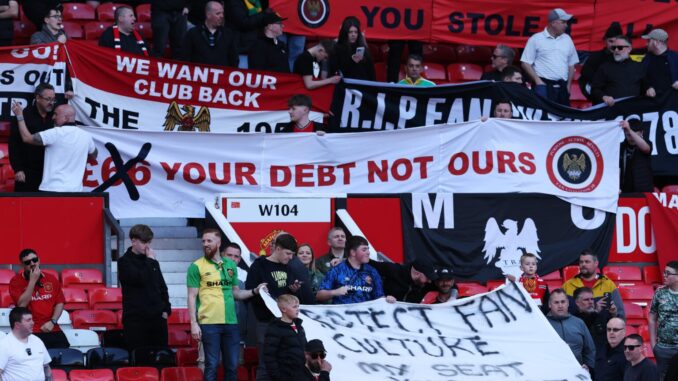
The Glazer family has, of course, not escaped criticism, especially among the hardcore element of the fanbase, which is protesting deeper issues than the ephemera of one season or the next.
However, it is Ratcliffe who – justifiably – has been primarily on the hook for the club’s costly decision to retain and then fire Erik ten Hag, a worst Premier League finish since the mid-1970s, and every other micro and macro disaster in M16 since his £1.25bn investment in February 2024.
The positives, such as the club’s current four-match unbeaten run or the ambition on show in the vision for a new 100,000-seater stadium, have been largely overshadowed.
So when Saudi royal and boxing powerbroker Turki Al-Sheikh let slip that a group of investors from the United Arab Emirates were at an ‘advanced stage’ of discussions to invest in the club, it inspired some optimism in some quarters of the fanbase.
The details, however, are – to put it charitably – a little hazy. Whose equity might this mystery group be purchasing? Is it a full takeover, a part-investment, a deal to underwrite the stadium, or something else?
Most football finance sources that TBR Football speaks to are highly sceptical that this would-be deal will ever come to fruition. The very fact that it is now in the public domain does not bode well. Dealmakers like a quiet process up until the point where it is impossible to contain.
That said, the Glazer family are now entitled to drag Ratcliffe along into a deal to sell the club outright if they receive an offer of $33 per share or higher. So if/when they do decide to sell, how will that decision be made among the six Glazer siblings?
Well, Edward Glazer’s resurfaced comments from an interview with the Kogod School of Business in April of this year provide some insight.
In the conversation, which at the time of writing has been viewed just a few hundred times on YouTube, the youngest Glazer sibling was asked what catalysed their decision to sell a quarter of the club to Ratcliffe.
He answered: “I think that… We’re a family business, and it was really a decision we made collectively.
“Not every decision is six-nothing. But ultimately, why we have been successful as a family business is that we’ve always kind of agreed that, if the majority of family members want to do something, we realise we’re in a family business and we have to do it.
“One day it might be something I’m in favour of. The next day, it may be something I’m not in favour. It was a family decision.”
His comment – and his body language during that section of the interview – suggest that the decision to part with 25 per cent of their investment was not unanimous.
Price was a sticking point when the siblings ultimately decided to realise only a portion of the value of their investment as opposed to the entire asset, which they are said to value at over £5bn.
Joel, Avram and, to a lesser extent, Bryan are the Glazer siblings most engaged with United on a day-to-day basis, but it sounds like a majority vote among the six could one day lead to a sale.
“Determining the motivations of the Glazer family has been difficult,” says Liverpool University football finance lecturer and Price of Football podcast co-host Kieran Maguire in exclusive conversation with TBR Football.
“At present, they consider themselves in an almost perfect situation. They are no longer seen as the decision makers at Old Trafford. If the Glazer family had announced redundancies, put ticket prices up to £66, kicked fans out of their seats to sell to tourists and so on, there would have been huge dissent.
“But all of that has come under Ineos and the fanbase has, in the main, been fairly acquiescent. They have swallowed the story that Ratcliffe is a United fan, disregarding the fact that he is a former Chelsea season ticket holder who tried to buy that club a few years ago. They have fallen for the PR spiel.
“The Glazers might have liked to implement some of these policies themselves but didn’t do so because they had been advised that it would have caused a lot of problems. They are now reaping the rewards financially.
“You only have to look at matchday income last season after a decade of flatlining. The share price is still 50 per cent higher than before they made the announcement that they were considering a sale.
“If Man United do become a success on the pitch, then that $33 per share valuation could rise significantly. Considering just how little money they have put into the club, that could be very beneficial for the Glazers.”
Leave a Reply